
By the age of three, most dogs and cats have some degree of dental disease. It’s the most common condition we diagnose, and it’s painful long before a pet shows it. Animals are very good at hiding a sore mouth.
How a Sore Mouth Actually Looks
Almost nobody brings us a pet because it stopped eating. Cats and dogs with painful teeth usually keep eating — they chew on the other side, swallow things whole, or get slower at the bowl. What people notice first, if anything, is:
- Breath that has gone from doggy to genuinely bad
- Dropping food, or chewing on one side
- Pawing at the face, or turning the head away from a hand
- Drooling, sometimes tinged with blood
- A tooth that looks discolored, or a gum line that has receded
- Nothing at all, which is the common one
A pet who perks up noticeably after a dental is the rule rather than the exception, and it is usually the owner who tells us — she’s playing again, and I thought that was just age.
Why We Anesthetize
The disease that matters happens below the gum line, where it can’t be seen or reached in a pet who is awake. A proper cleaning means charting every tooth, taking full-mouth radiographs, cleaning under the gum line, and treating what we find. None of that is possible on a conscious patient, and scraping visible tartar off an awake one treats the appearance of the problem rather than the problem.
This is also why we don’t offer, and would gently talk you out of, anesthesia-free dental cleaning. It polishes the part of the tooth you can see while leaving the diseased part untouched, so the mouth looks better and the painful teeth stay painful — and the pet is restrained for the privilege. It makes a problem harder to spot, not smaller.
Every dental patient gets pre-anesthetic bloodwork, an individual anesthetic plan, IV fluids, and monitoring throughout by a dedicated team member.
What the Day Looks Like
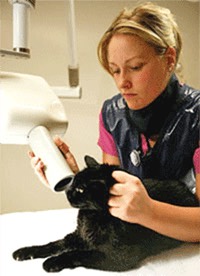
Your pet comes in during the morning, with no breakfast. We examine them, place an IV catheter, and give an anesthetic chosen for that animal’s age and health. Once asleep, we chart every tooth and take full-mouth radiographs — the step that finds what the eye can’t. We clean above and below the gum line, treat whatever the images show, polish, and wake them up with someone sitting with them.
If we find a tooth that has to come out, we’ll call you before we do it. You’ll go home the same afternoon with pain medication and a plan.
What We Treat
- Periodontal disease, at every stage
- Fractured and worn teeth
- Feline tooth resorption
- Retained deciduous teeth in young animals
- Oral masses
About Extractions
People dread this part, and they shouldn’t. A diseased or resorbing tooth is a source of constant pain, and leaving it in place isn’t kindness. Pets eat perfectly well without teeth — cats who have had full-mouth extractions for stomatitis routinely go back to dry food within weeks, and their owners describe them as a different animal.
Extractions are done with local blocks on top of the general anesthetic, and pain medication goes home with you.
At Home
Daily brushing is the single most effective thing you can do, and it’s worth learning even if it feels hopeless at first. If brushing isn’t going to happen in your household, tell us. There are dental diets, chews, and water additives that help, and we’d rather recommend something you’ll keep doing than something you’ll abandon in a week.
One thing to avoid: hard chews. Antlers, bones, hooves, and nylon chews are the most common cause of fractured teeth we see. The rule of thumb is that if you can’t make a dent in it with your thumbnail, it’s harder than the tooth.